Showing posts with label Health and Fitness. Show all posts

Thursday, April 14, 2011

A physio's inspiring story


Today we'd like you to meet Rowena Kendall, a physiotherapist at Lifecare in Cottesloe. When a friend of hers passed away last year from cystic fibrosis, Rowena decided to do the Rottnest Channel Swin solo to fundraise for CFWA. She made it to Rotto in 6 hours and 16 minutes and raised just over $32,000.

Rowena found some busy time in her schedule to chat to Sports Fever about her job, her preparation for the race and her experience. We hope you are inspired by her story as much as we were.

What do you love most about being a physio?

The interaction with so many different people every day. I physio for the WA womens hockey team (the diamonds), and its great to be able to travel with them and work with the girls and the coaching staff to get every player in the best shape possible for each game.

How did you feel in the lead up to the swim?

Very nervous! I actually went to Japan snowboarding for two weeks and only got back the week before the race, so I was pretty worried that all my training had gone down the drain. I was swimming pretty strongly before that, so I didn't want to get home and feel like I'd lost it all.

I was also really worried about the weather, as there had been a cylcone up north that was looking a bit threatening the week leading up to the race... I knew that as long as the race wasn't called off due to bad weather, I'd get to Rotto, but I was concerned that the race would be cancelled and I wouldn't get a chance to swim. Given that I had about $30,000 in donations resting on it at that stage (fundraising for Cystic Fibrosis WA), I was a bit worried I'd have to give it all back and try again next year!

How did you get ready for the event?

I was training with Kirby Swim at Christchurch, as well as Peter Tanham's squad at Challenge Stadium (Peter has done over 20 solo crossings!). I was trying to swim between 25 to 35km per week. My biggest week was about 40km. Unfortunately the 10km 'Rotto Rehearsal' swim was cancelled, so I didn't get to practice a 10km open water swim prior to the race, which was a shame. And lots of eating!

Have you ever done an event like this before?

I did the Rotto swim solo in 2009 for the first time, and vowed never to do it again after that... The fundraising for CFWA was the motivating factor this time, but I can't see myself doing it again in a hurry! I've done the swim 8 times now, 3 duos, 3 teams of 4 and 2 solos.

How did you feel when you finished?

Relief. There were a few tears at the finish line when I saw my family and Sal's family (Sal was a friend who passed away from cystic fibrosis, and was the motivation behind the swim).

Tuesday, April 5, 2011

Running away from pain

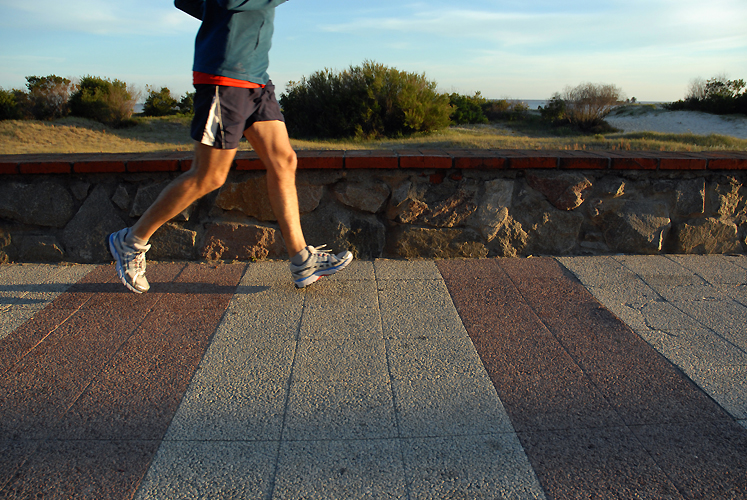
If you are new to running, you may be experiencing some common ailments or injuries. According to Dave Moala from Bayswater Physiotherapy the most common runners conditions are tibial tenoperostitis (pain on the inside border of the tibia or shin bone, commonly referred to as “shin splints”), achilles tendon pain/injury and anterior knee pain (patello-femoral/knee cap pain).

The causes for these three problems are also varied, but Dave says they can be loosely grouped into three categories, musculoskeletal and biochemical factors, training regimes and footwear.

Musculoskeletal and biomechanical factors include joint stiffness or mobility, inadequate tissue length and muscle strength or poor biomechanics e.g. excessive pronation/flat feet. Your issues may also be caused by inappropriate exercise or running programs, inadequate warming up and down and over training with inadequate recovery time between sessions. If none of these ring a bell, Dave advises checking your footwear as over used, too old or incorrect shoe type and fitting can also be a culprit.

So what can you do to ensure your running is pain free? “When running for the first time it is essential to ease very slowly into the running program and to build up levels gently and appropriately, paying attention to adequate warming up and down, hydration and recovery time between sessions,” Dave advises. “It is also paramount to have appropriately and correctly fitted running shoes – a must.”

Dave says if you are experiencing problems it is worth looking at your running style. “As everyone’s running style is individual and different it is hard to determine the correct running style,” he says. “This is best assessed by the runner being observed by a running/athletics coach or by educated staff such as those at Sports Fever.”

Having realistic goals and the right footwear will also make a big difference, Dave says. “Running is suitable for all ages and fitness levels and not trying to be unrealistic with their outcomes/goals provided people are running at age and fitness appropriate levels,” he says.

“Obviously, if you are older and more unfit your running will be at an appropriately lower level and of frequency, speed, duration and intensity.

“Correct footwear is essential to prevent injury, maintain lower limb integrity, ensure maximum comfort/support and to promote maximum efficiency. Running is one of the best forms of exercise in terms of time, convenience and results. So get your shoes from Sport Fever, get motivated and get running!”

Tuesday, March 22, 2011

Athlete Q&A: Katrina Mercer Part 2

Last week we introduced you to Katrina Mercer, an elite triathlete sponsored by Sports Fever. Here's part two of our chat as Katrina shares her nutrition and training routine.

What is your nutrition like on a normal day? 

Nutrition on a normal day includes a lot of carbohydrate and protein based foods. I tend to limit saturated fat intake. I need to make sure I eat certain foods before, during and after training sessions to ensure proper recovery – especially as at the moment as I am training for the Busselton Half Ironman and a lot of the sessions are 2 – 4 hours twice a day.

The type of foods I eat include wholegrain cereals, breads, rice, lots of fruit and vegetables, red meat (for iron), fish, chicken, tofu, low fat yogurt and diary, most days will also include a treat too!

What is your training routine like? 

A typical training week will be about 12 – 14 sessions broken into 4 swims, 4 cycle sessions, 4 run sessions & some yoga/core strength work.

Swimming: each session is about 4km in duration and focuses on speed, endurance, open water swim skills.

Cycling: the sessions vary from 50km – 120km. Some will be endurance sessions, which involve rides to the hills or down the freeway. Others focus on strength & speed and will be intervals or hill climbing.

Running: varies from 10km – 25km. Some will be longer endurance runs for up to 2hours and others are focused on strength & speed. My runs are usually around Kings Park, Nedlands, Perry Lakes & Cottesloe.

I also attend two yoga classes per week and practice core strength exercises to ensure I recover well and don’t get any injuries.

Thursday, March 17, 2011

Athlete Q&A: Katrina Mercer

At Sports Fever we’ve always been proud to support the local sporting industry and of course, our local athletes. Katrina Mercer is an elite triathlete and one of the athletes we sponsor.

Katrina was happy to take some time out of her busy training schedule to answer some of our questions.

How did you get into triathlon? 

I started swimming and little athletics when I was in early primary school then began competing in running events through school before following my dad and brother into triathlon when I was 15. From there I competed in National Schools Triathlon Championships & National Cross Country Championships. My parents have always been very fitness focused which lead me on the same path.

What drew you to compete in triathlon? 

Because I had competed in so many different sports when I was young, I found it hard to just focus on one and leave all the others. I was doing well in both swimming and running in high school and decided to give triathlon a go so I could pursue both of them. The challenge of getting all three disciplines going well at once is addictive.

What are your main achievements to date? 
  • Triathlon Western Australia 2010 Open Female Triathlete of the Year 
  • 3rd Professional – Busselton Half Ironman 2010 
  • 8th World Age-Group Champs – Goldcoast 2009 
  • 4th World Age-Group Champs – Vancouver 2008 
  • 1st State Road Run Champs - Perth 2009 
  • 1st State Sprint Triathlon Champs - Rockingham 2008 


Make sure you check back to our blog next week for part 2 of our Q&A where Katrina talks about her nutrition and training routines. 

Thursday, March 3, 2011

Kids Feet and Exercise

The make-up of children’s feet may discourage them from being active, a new study has shown. The study featured in the January 2011 issue of The Journal of Science and Medicine in Sport, is the first to determine whether foot pressures generated during walking by preschool children were related to time spent in physical activity and sedentary behaviour.

Results showed children who experience greater pressures on the plantar surface of the foot may suffer more pain and discomfort during weight bearing activities which in turn may act as a barrier to physical activity.

Author of the study, Karen Mickle from the Biomechanics Research Laboratory, School of Health Sciences, University of Wollongong said further research needs to be done to reduce plantar pressures in inactive children so they can enjoy the benefits associated with participating in a more active lifestyle.

“Participation in physical activity provides numerous benefits for children including improved cardiovascular risk factors, muscular strength and endurance, skeletal health, mental health and academic performance,” she said.

“Given the health benefits of physical activity for preschool children and the proportions who do not meet recommended levels for physical activity, better understanding of the factors that influence such behaviours among young children is paramount for successful efforts and for public health promotion.

“Identifying children who have foot discomfort associated with high plantar pressures may be an important step in removing a potential barrier to these children participating in physical activity."

How to act on your child’s foot discomfort:
  • Provide comfortable, well fitting shoes that reduce pressure under the foot. This may reduce foot discomfort whilst children participate in physical activity.
  • Promote activities that reduce loading on the feet, such as cycling and swimming, as this may also encourage children with foot discomfort to be more physically active.

Thursday, February 10, 2011

Inspired by the Oz Open?

With The Australian Tennis Open inspiring many to take to the sport, tennis players can get an advantage via Sports Medicine Australia’s Preventing Tennis Injuries Fact Sheet.

The rate of tennis injuries has been calculated at five injuries per 1,000 hours of participation. The most common injuries are to the lower limbs – ankle, knee and thigh.

“Every year once The Australian Tennis Open is over and won people are inspired to start playing tennis, often without appropriate preparation. Sadly, this is a recipe for injury,” Sports Medicine Australia’s spokesperson, Dr Anita Green said.

“However many common tennis injuries can be prevented by undertaking good preparation in the form of hydration, warming up, using appropriate equipment and practising good technique,” Dr Green said.

Sports Medicine Australia offers these tips to get prepared and minimise the risk of tennis injury:
  • Always warm up, stretch and cool down
  • Maintain an adequate fitness level. Undertake specific conditioning and training exercises that simulate tennis (i.e. acceleration, deceleration, twisting, turning and stretching).
  • Seek instruction from a qualified coach to develop correct skills and techniques.
  • Avoid over-repetition of any one type of shot. Practise a range of strokes including groundstrokes, serves, return of serves, overhead smashes and volleys.
  • Use a racquet suitable for your style of play and physical capabilities.
  • Check and maintain the playing surface to ensure it is in good condition and free of hazards. A tennis ground checklist can help.
  • Seek professional advice on footwear.
  • Be sun smart to protect from heat injury. Wear sun-protective clothing, a hat, sunglasses and SPF 30+ sunscreen.

To download the Preventing Tennis Injuries Fact Sheet visit sma.org.au. Sports Fever is here to help with offering professional advice on footwear and if you're getting in to tennis make sure you swing by our Cottesloe store and check out our Wilson concept area and stringing machine!

Monday, January 24, 2011

Walking still the Aussie favourite

Approximately two thirds (64%) of Australians aged 15 and over participated in at least one sport or physical recreational activity in the last twelve months, according to figures released by the Australian Bureau of Statistics (ABS). Unfortunately this participation rate has fallen from 66% when the survey was last undertaken in 2005-2006.

The three most popular sport or physical recreational activities participated in by Australians were walking for exercise (23%); aerobics, fitness and gym activities (14%); and swimming and/or diving (7%). Women reported higher participation rates in each of these activities than men. Walking for exercise was also reported to be the most popular activity when the survey was last conducted in 2005-06.

Participation rates for residents in the Australian Capital Territory and Northern Territory were the highest of all Australian states and territories, with participation rates of 77% and 72% respectively.

Overall, the most popular facilities used for participating in sport and physical recreational activities were parks, beaches and walking trails, with 58% of participants using these facilities.

Further information is available in Participation in Sport and Physical Recreation, Australia 2009-10 at http://www.abs.gov.au. If you want to find out if you're wearing the right shoes for walking for fitness, pop into your local Sports Fever stores and we will help fit you for the right shoes.

Monday, January 10, 2011

Don’t Let Injury Stop you

Safety precautions should play part in New Year ‘get fit’ resolutions to avoid injury, advises Sports Medicine Australia.

During January, many enthusiasts start new exercise regimes to get fit and lose weight gained over the festive season. However, without taking suitable safety precautions before starting activities, injuries can occur – postponing any fitness benefits.

Each year one in 17 Australians is sidelined as result of a sports injury, making injuries one of the major barriers to participation.

Sports Medicine Australia spokesperson, Dr David Bolzonello says this need not be the case, as up to half of all sporting injuries are able to be prevented.

“At the start of every year, many people dive into their New Year’s resolution of physical activity without good preparation and suffer injuries that restrict their steady progress toward their fitness goal,” Dr Bolzonello says.

“The risk of injuries should not deter people’s enthusiasm and motivation to get fit and healthy. All they need to remember is to undertake some simple measures before, during and after physical activity.

“This preparation should reduce the likelihood of getting injured and increase the chances of a happily fulfilled New Year resolution.”

To assist in achieving an injury-free New Year resolution, Sports Medicine Australia offers the following timely advice:

  • Avoid doing too much too soon. Start at a level and pace you’re comfortable with. Gradually increase your workload over a series of sessions. 
  • Always warm up and cool down when undertaking activity. Warming up prepares you both mentally and physically for performance and decreases your risk of being injured. To warm up, simply start your chosen activity at a slower pace. Also remember to cool down after activity sessions to help reduce muscle soreness and stiffness. 
  • Take care when exercising in hot conditions, which are common in January. During activity, try to rest in the shade whenever possible and protect yourself by wearing light clothing, sunscreen, sunglasses and a hat. 
  • Always drink fluids (water or a sports drink) before, during and after activity. Drink at least 2 cups (500ml) an hour before exercise, 150ml every 15 minutes during exercise and enough to fully re-hydrate yourself after exercise. 
  • Wear protective equipment such as helmets, padding and/or mouthguards, where required. Good quality footwear are also a must as a number of studies have found a relationship between the type of footwear worn and the incidence of injuries to the lower limb. 
  • Know what to do if an injury occurs, especially if you have suffered an injury in the last 12 months. Injury statistics have found previous injury increases the risk of further injury by 57%. Use RICER – Rest, Ice, Compression, Elevation and Referral. 
What steps are you taking to prevent injury this year? Hit comment below and share your thoughts with other readers!

Tuesday, January 4, 2011

Need a Podiatrist?


Do your wear orthotics or a corrective device? Or are you finding you get pain in your feet, knees or back when you run?

We all need a good podiatrist, physiotherapist and sports trainer in our life, even if it is a one off visit. Some people’s feet need more than a good shoe; some injuries need the advice of a good physiotherapist or sports doctor.

The Sports Fever staff can and will direct you to the best people in your area, importantly they see a lot of customers who are already wearing corrective devices / orthotics and so have the ability to fit the correct footwear without over correcting. A properly fitted shoe does make a difference!

Give us a call or pop into a store and we will help you find the right person. Or post a comment below or visit us on Facebook – www.facebook.com/sportsfever

Wednesday, December 29, 2010

Summer Safety Tips

So you read our post on why summer safety is important? Here are some suggestions from Sports Medicine Australia to keep you safe in the heat.
  • Stay hydrated by drinking water before, during and after exercise. 
  • Schedule activity to avoid the hottest part of the day. 
  • Take rest breaks, in the shade if possible. 
  • Wear light coloured, lightweight and loose fitting clothing that allows easy evaporation of sweat from the skin. Wear sunglasses, 30+ sunscreen and a hat. 
  • Reduce the duration and intensity of a warm up to minimise an increase in body heat and temperature. 
  • Do not take part in strenuous activity if you have recently experienced a high temperature, infection, diarrhoea or vomiting. 
  • If you have a medical condition such as asthma, diabetes, a heart problem, epilepsy or obesity, are taking medication, or are pregnant; you may experience difficulties exercising in the heat. If unsure you should seek advice from a sports medicine professional. 
  • Persons suffering from heat illness can recover rapidly with assistance – laying down in a cool place, removing excess clothing, wetting skin or using ice packs, and drinking cool water. However if symptoms do not improve, seek medical assistance.

Wednesday, December 22, 2010

Exercise Safely During Summer

During summer those who are active need to prepare for hot weather conditions or risk heat injury, warns Sports Medicine Australia.

Being active in hot or humid conditions can lead to dehydration, heat illness and sometimes the more serious consequence of heat stroke.

Sports Medicine Australia spokesperson Dr Anita Green says while physical activity is important for overall health, in the hotter months certain precautions need to be taken to avoid heat injuries.

"Heat illness is a serious matter that can result in the life-threatening condition of heat stroke, if left untreated," Dr Green says. "While people need to exercise regularly to stay healthy, they should take certain precautions if exercising in a hot or humid environment.

"Those exercising need to know what can contribute to heat illness, such as high air temperature, heavy clothing, high humidity, lack of fitness and high exercise intensity. They should also know the symptoms of heat illness – light-headedness, nausea, headache, confusion, not sweating, and aggressive or irrational behaviour.

"Knowing how to prepare for heat illness, what causes it and what to look out for will help to avoid it."

Children are at a greater risk as their bodies respond less efficiently to heat, feel hotter and have greater difficulty getting rid of heat from their body.